
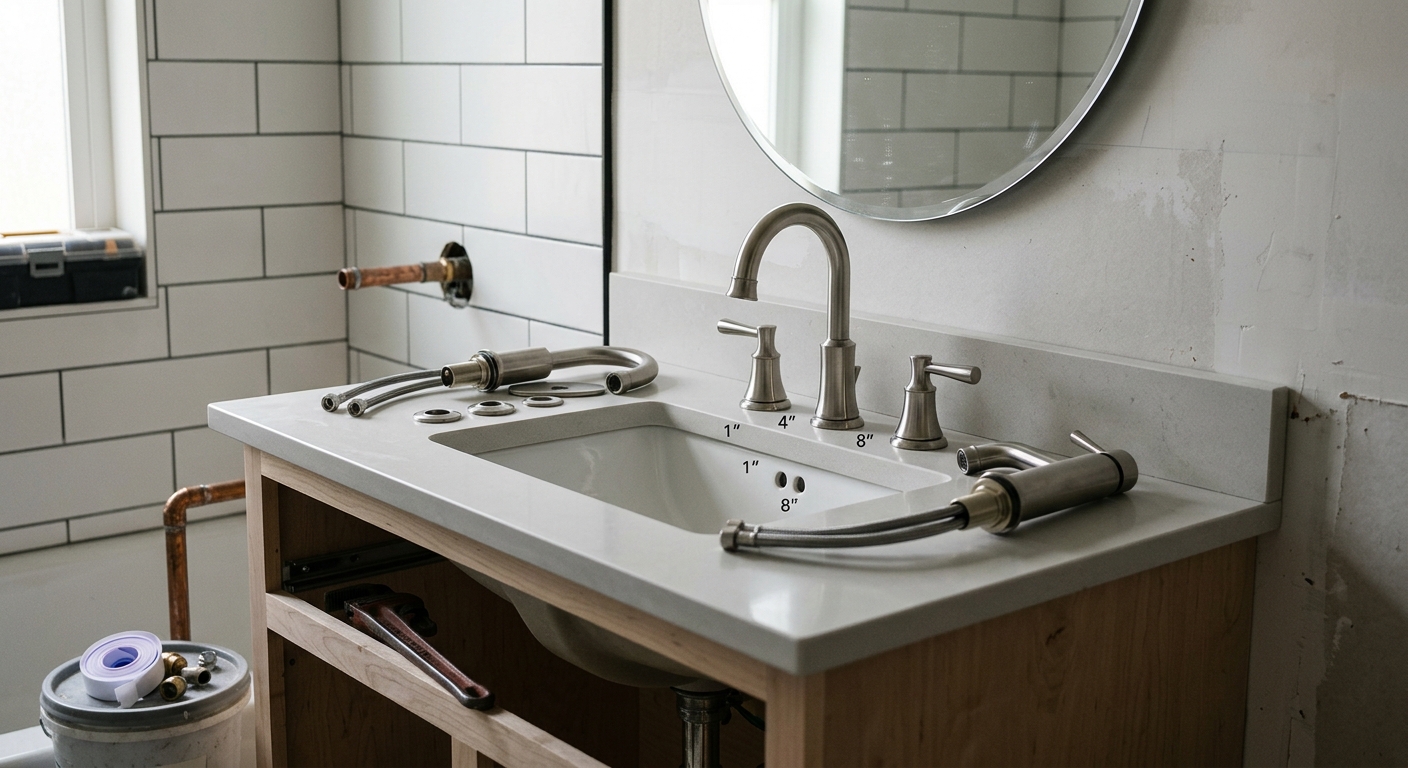
Pick one hole configuration and standardize it across every room class before you finalize countertop shop drawings. The choice between centerset and widespread is not a style decision made room-by-room, it is a procurement decision that locks in your countertop SKU count, your rough-in plumbing template, and your fabrication lead time months before the first vanity ships. Get it wrong and you are change-ordering stone tops or swapping faucet trim after install.
Why Hole Spacing Drives the Whole Spec
Every vanity top in your FF&E package is fabricated with faucet holes pre-cut to a specific spread. Once that stone or solid-surface top leaves the fab shop, the hole spacing is fixed. If your faucet spec changes after templating, you are not swapping a fixture, you are re-fabricating a countertop or living with a mismatched escutcheon plate covering extra holes. On a renovation with 150 to 300 keys, that is not a rounding error, it is a line item that shows up in your change order log.
The hole configuration also determines your rough-in. Centerset faucets land on a single valve body behind the wall or deck. Widespread faucets require three separate supply penetrations spaced 8 inches on center, which means your plumber is setting three stub-outs per lavatory instead of one. On new construction that is a minor coordination item. On a gut renovation with existing wall chases, it can mean relocating supply lines in rooms where you have no spare space.
Centerset vs Widespread: Cost Per Key
Standard centerset spread is 4 inches on center. Widespread is typically 8 inches on center, though some commercial lines run wider. The cost delta is not just the faucet unit price, it is the labor and SKU complexity multiplied by key count.
- Faucet unit cost: Widespread trim generally runs higher than centerset because you are buying three separate components (two handles, one spout) instead of one unified body.
- Installation labor: Widespread takes longer to set and align per unit, since the installer is leveling three separate pieces to a single spread rather than setting one fixture.
- Rough-in labor: Three supply penetrations versus one adds plumber time per lavatory, multiplied across every guest room.
- Countertop fabrication: Three holes cut and polished versus one hole (or three holes close together for a centerset) changes the fab shop’s per-unit cutting time and scrap risk.
On a per-key basis, these increments compound. A 200-key property converting from centerset to widespread across all guest bathrooms is adding cost at the faucet line, the plumbing labor line, and the countertop fabrication line simultaneously. If your FF&E budget is built per key, run the delta on all three line items before you commit to widespread as the standard, not just the fixture price on the cut sheet.
Single-Hole Faucets in ADA Rooms
ADA-compliant rooms carry a hard constraint that affects which hole configuration works at the vanity: a 27-inch knee clearance is required under the lavatory for forward approach, measured from the floor to the bottom of the apron. This clearance requirement interacts with faucet selection in two ways.
First, the lavatory itself typically needs a shallower apron or a wall-mounted basin to hit the 27-inch figure, which limits deck thickness and can constrain how much deck space you have for a widespread spread. Second, single-hole faucets with lever handles are easier to specify for ADA rooms because they satisfy the operable-parts requirement without a separate accessibility review of two-handle reach and grip. A single-hole deck-mount with a lever handle lets one hand operate the faucet without pinching or twisting, which is the functional requirement ADA is checking for regardless of hole count.
If your ADA room count is 5 percent of total keys (a common minimum under most accessibility codes, though your local code may require more), you already have a second faucet SKU in the mix unless you standardize single-hole across the entire property. That is worth evaluating before you assume ADA rooms are a minor carve-out.
Counter Fabrication Lead Times by Type
Hole configuration affects fabrication schedule, not just unit cost. Single-hole tops are the fastest to template and cut because there is one penetration to locate and one tolerance to hold. Centerset tops add modest time since the three holes are close together and typically pre-templated as a single punch pattern by the fabricator. Widespread tops take longest because the fabricator has to hold tolerance across an 8-inch spread, and any deviation in faucet spacing between manufacturers can mean the holes do not align with field-measured rough-in.
On a renovation timeline where countertop fabrication is on the critical path, this matters. If you are ordering stone tops from a single fab shop for 200+ rooms, template accuracy and turnaround on widespread tops can run longer than centerset or single-hole, particularly if the shop is also producing custom edge profiles or waterfall details. Confirm lead times with your fabricator against your faucet spread choice before you set the overall FF&E delivery schedule, not after.
One Faucet Type Across All Room Classes
The procurement case for standardizing one hole configuration across king rooms, double-queens, suites, and ADA rooms is straightforward: fewer SKUs means fewer purchase orders, fewer warehousing line items, and fewer opportunities for an installer to grab the wrong faucet for the wrong countertop template. It also simplifies parts inventory for your facilities team after opening, since aerators, cartridges, and handle kits are interchangeable across every guest bathroom instead of split across two or three faucet families.
If you are evaluating a single vendor platform to standardize on, look at lines built for commercial spread consistency rather than mixing residential-grade trim across your spec. For example, a line of widespread bathroom faucets built to a consistent 8-inch spread can serve as the one SKU across standard rooms, provided your ADA rooms are carved out separately with single-hole trim where the knee-clearance and lever-handle requirements call for it. The goal is not zero SKUs, it is the minimum SKU count that satisfies both your standard rooms and your accessibility requirements.
Locking Aerator Flow Rates to the Spec
WaterSense-rated basin faucets cap flow at 1.2 GPM (4.5 LPM), and specifying WaterSense-rated aerators across your entire faucet package is one of the few FF&E decisions that pays back directly in utility cost without affecting guest experience. Unlike shower heads, where flow rate is more noticeable to guests, basin faucet flow at 1.2 GPM versus a higher-flow aerator is rarely something a guest will comment on, but it is something your utility bill will reflect across 200+ rooms running multiple times a day.
Lock the aerator flow rate into your faucet spec sheet as a line item, not an assumption. Some faucet SKUs ship with a non-WaterSense aerator by default and require a specific order code or aftermarket swap to hit 1.2 GPM. Confirm the aerator rating on the actual SKU you are purchasing, not just the faucet family’s marketing spec, since manufacturers sometimes offer the same body with multiple aerator options.
| Configuration | Hole Spread | Rough-In Penetrations | Typical Use Case |
|---|---|---|---|
| Single-hole | 1 hole | 1 | ADA rooms, compact vanities |
| Centerset | 4 inches | 1 (unified base) | Standard guest rooms, budget-driven specs |
| Widespread | 8 inches (typical) | 3 | Suites, upscale room classes |
Before you release countertop shop drawings, confirm three things with your fabricator and plumbing contractor: the exact hole spread on the faucet SKU you are purchasing (not just the product family), the ADA knee-clearance dimension on every accessible vanity, and the aerator flow rating on the actual unit shipping to site. If you are standardizing one configuration across room classes, get that confirmation in writing from your fixture vendor before the first countertop template is cut, not after the first room mockup reveals a mismatch.