
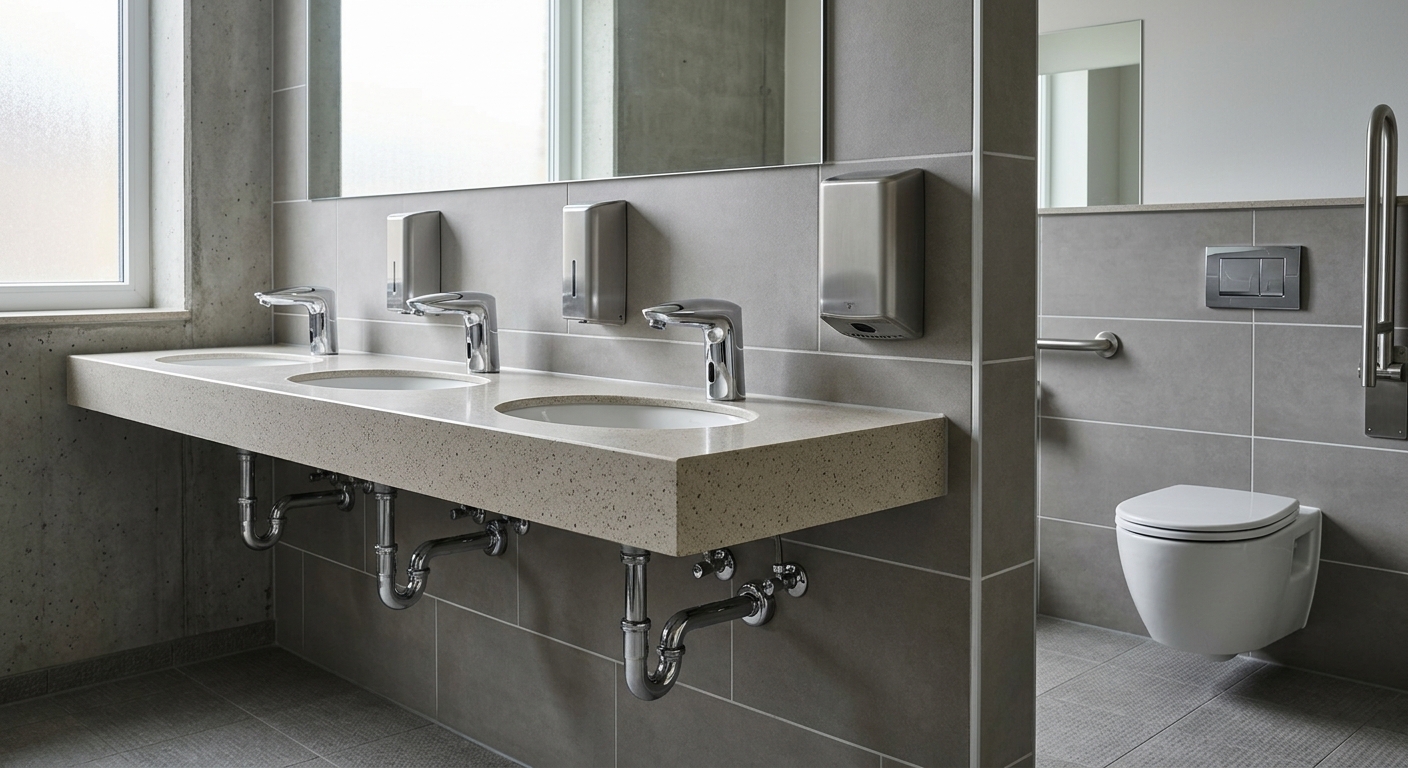
The fixtures that cut housekeeping time most are the ones that resist mineral scale, hide water spots, and reduce the number of separate surfaces a room attendant has to touch. Solid surface shower walls instead of tiled ones, pressure-balance or thermostatic valves with wipeable trim, and wall-hung toilets with exposed-clean floors save real labor minutes per turn. Touchless faucets and flush valves help less than vendors claim once you account for battery service calls, so they need to be evaluated as a maintenance trade, not a cleaning win.
Why Turn Time Is an FF&E Metric
Room attendants are budgeted a fixed number of minutes per stay-over and per checkout clean, typically set by the housekeeping labor model, not the FF&E spec. When a bathroom fixture adds even 90 seconds to a clean because of grout lines, water spotting, or a valve trim that needs polishing, that cost repeats every single turn for the life of the room, which is usually 7 to 10 years before a soft-goods refresh and 15 to 20 years before a full case-good and plumbing replacement.
FF&E buyers price fixtures against purchase cost and durability. The missing column is labor cost per turn multiplied by turns per year. A $40 upsell on a valve or a $200 upsell on a shower base only pencils out if it removes minutes from the clean, not because it looks better in the rendering.
Shower Valves and Scale Resistance
Pressure-balance cartridges are cheaper to spec and simpler to service, but they use rubber diaphragms and moving parts that collect mineral scale in hard water markets, and the exposed trim ring around the handle is a common spot for water residue and soap film. Thermostatic valves cost more up front and require a technician for cartridge replacement, but many use ceramic disc technology with fewer scale traps and a fixed-temperature dial that guests touch less, which means less fingerprint and water spotting on the trim.
In hard water markets (over roughly 120 mg/L hardness), the cleaning-time difference between the two valve types is measurable, since pressure-balance trim needs more frequent wipe-downs to keep the finish free of spotting. In soft water markets the gap narrows and pressure-balance valves are the better value.
- Hard water property: thermostatic valve with brushed or matte PVD finish, which hides water spotting better than polished chrome.
- Soft water property: pressure-balance valve is adequate; spend the delta on shower wall material instead.
- Either case: avoid polished chrome trim in guest-facing bathrooms above budget-tier properties. It shows every water spot and fingerprint under bathroom lighting.
Vanity Surfaces Versus Grout Lines
Solid surface and quartz vanity tops with integrated or under-mount sinks eliminate the seam between counter and basin, which is the single biggest soap-scum trap on a vanity. A separate drop-in sink with a caulked seam needs that seam scrubbed and re-caulked on a maintenance cycle, and the caulk line itself is a housekeeping flag point during quality inspections.
Tiled shower and tub surrounds carry the same problem at a larger scale. Every grout line is a place mildew and hard water deposits can start, and grout is porous unless it is epoxy-based, which raises the base cost. A nonporous solid surface shower wall panel system has no grout lines to scrub, no caulk to inspect, and no re-grouting line item in the five-year capital plan.
The labor difference is not marginal. A tiled shower stall with standard grout typically needs periodic deep cleaning with a grout brush or steam tool that a daily turn clean does not include, meaning it gets pushed to a supplemental deep-clean schedule, which is itself a labor cost the tile spec created. Solid surface panels get the same daily wipe-down as the rest of the bath and rarely need a separate deep-clean cycle for the walls themselves.
| Surface | Daily clean time impact | Deep clean cycle needed |
|---|---|---|
| Tiled shower wall, standard grout | Baseline | Yes, quarterly or as scheduled |
| Tiled shower wall, epoxy grout | Slightly better than standard grout | Reduced frequency |
| Solid surface panel, no seams | Fastest wipe-down | Rarely required |
| Vanity top with integrated sink | Faster than drop-in with caulk seam | No caulk maintenance |
Toilets and Grab Bars That Wipe Fast
Wall-hung toilets with a concealed in-wall tank clear the floor for a single unbroken wipe underneath and around the base, which is where a floor-mounted toilet traps hair, dust, and cleaning residue around the bolt caps and the base-to-floor seam. Floor-mounted units are less expensive to install and are still standard in most midscale properties, but if the project is upscale or extended-stay with heavier daily cleans, the wall-hung option earns back some of its premium in reduced under-toilet scrubbing time.
Grab bars need to meet ADA operable-parts and mounting requirements regardless of cleaning considerations, with horizontal bars typically mounted 33 to 36 inches above the finished floor. From a housekeeping standpoint, a knurled or textured grab bar grips better for guests but collects more residue in the texture pattern than a smooth stainless bar, so specify smooth finish where code allows the alternative, and reserve textured grip surfaces for the tub or shower bar where wet-grip performance is the priority over wipe speed.
Touchless Fixtures and Battery Maintenance
Touchless faucets and flush valves reduce the surface contact guests leave on chrome and reduce fingerprint wipe-downs during the visual turn inspection, which is a real but modest saving. The trade-off is battery service. Most sensor faucets and flush valves run on AA or lithium battery packs rated for a set number of cycles, and in a high-turnover property that number gets reached faster than the vendor’s marketed lifespan suggests, because a mid-scale or upper-midscale hotel cycles far more flushes and faucet activations per room per year than a residential bathroom.
Battery replacement is an engineering work order, not a housekeeping task, so it does not show up in the room-attendant labor line, but it does show up in engineering payroll and in parts inventory. Before specifying touchless across a full property, get the battery life rating in cycles from the manufacturer and multiply by your expected annual activations per fixture to estimate replacement frequency, and weigh that against the modest cleaning-time saving before treating touchless as a default upgrade.
Budgeting Cleanability Per Key
Bathroom fixtures (valves, sinks, toilets, grab bars, and accessories, excluding tile and vanity casework) typically run 8 to 12 percent of total per-key FF&E budget on a full-service or upper-midscale build. Within that band, the cleanability upgrades worth prioritizing are the ones that remove a recurring labor task: seamless solid surface shower walls over tile, integrated-sink vanity tops over drop-in with caulk, and wall-hung toilets in properties with heavier daily cleans. The upgrades that add spec cost without moving turn time are decorative trim finishes beyond what’s needed for water-spot resistance, and touchless conversions in low-turnover extended-stay product where the battery service burden outweighs the wipe-down saving.
Run the comparison as a five-year total cost line: purchase price, plus labor minutes per turn multiplied by annual turns, plus any deep-clean or battery-service labor the option creates. That number, not the showroom finish, is what should decide the spec.
Next Steps
- Get your local water hardness reading before finalizing valve type; it changes the thermostatic-versus-pressure-balance decision.
- Ask your housekeeping director for actual minutes-per-turn data on your current property before assuming any fixture upgrade will move the number.
- Request battery cycle ratings in writing from any touchless fixture vendor and run the math against your projected annual activations.
- Confirm grab bar mounting height (33 to 36 inches to centerline) and reach ranges with your architect against current ADA and any state-specific accessibility code before bid.