Hotel Bathroom Water Systems: Flow, Energy & Fixture Coordination
Sustainable hotel bathroom design requires more than selecting a faucet, showerhead or toilet with a low published flow rate. Water consumption, domestic hot-water energy, flushing performance, sensor timing, operating pressure, leakage, service access, fixture lifespan and post-installation commissioning all influence whether an apparently efficient bathroom continues performing efficiently after the property opens.
AEC teams should treat the hotel bathroom as an integrated water system. Guestroom shower demand, lavatory flow, toilet flushing, public-restroom sensing, hot-water generation, pressure conditions, maintenance and metering should be coordinated together rather than evaluated as isolated fixture decisions.
Technical References for Hotel Water Efficiency & Fixture Specification
Sustainable hospitality fixture decisions should be grounded in independent water-efficiency, accessibility, plumbing-engineering and whole-building guidance. Manufacturer claims should be verified against exact product performance and project requirements.
Hotel Bathroom Fixture Platforms by Water-Efficiency Priority
Different manufacturers address sustainability through different technologies. The most appropriate platform depends on whether the project priority is guestroom shower demand, WaterSense coverage, public-restroom water control or whole-bathroom coordination.
Compare Hotel Bathroom Water-Efficiency Platforms
Hotel Bathroom Brands Compared for Water & Energy Efficiency
| Brand | Low-Flow Showers | Efficient Faucets | Efficient Toilets | Touchless | Hotel Focus | Primary Sustainability Role |
|---|---|---|---|---|---|---|
| Hansgrohe | Outstanding | Outstanding | Strong | Moderate | Outstanding | Water + hot-water energy reduction |
| Kohler | Outstanding | Outstanding | Outstanding | Strong | Outstanding | Broad WaterSense specification |
| Roca | Excellent | Outstanding | Outstanding | Excellent | Excellent | Integrated water-saving technology |
| Sloan | Limited | Outstanding | Outstanding | Outstanding | Outstanding | High-frequency public-restroom efficiency |
| FontanaShowers™ | Excellent | Outstanding | Moderate | Outstanding | Outstanding | Architectural touchless water control |
| BathSelect™ | Excellent | Outstanding | Moderate | Outstanding | Outstanding | Hospitality shower + sensor coordination |


Hansgrohe EcoSmart
Hansgrohe has one of the clearest hospitality-oriented water-efficiency approaches in this comparison. EcoSmart technology limits fixture flow, reducing potable water demand while also lowering the quantity of hot water that must be generated for guestroom showers.
This water-energy relationship is especially important in large hotels. Shower-flow reductions can influence potable-water use, wastewater and domestic hot-water heating simultaneously. Project teams should still test selected showers at actual project pressure to confirm acceptable coverage and guest comfort.


Kohler
Kohler provides broad WaterSense-oriented bathroom coverage, allowing hotel teams to pursue efficiency across lavatory faucets, showering products and toilets instead of relying on one isolated low-flow component.
For branded and luxury properties, this can simplify scheduling and bathroom coordination across multiple room types. WaterSense status, flow, flush performance and certification should still be confirmed at the exact product-model level.
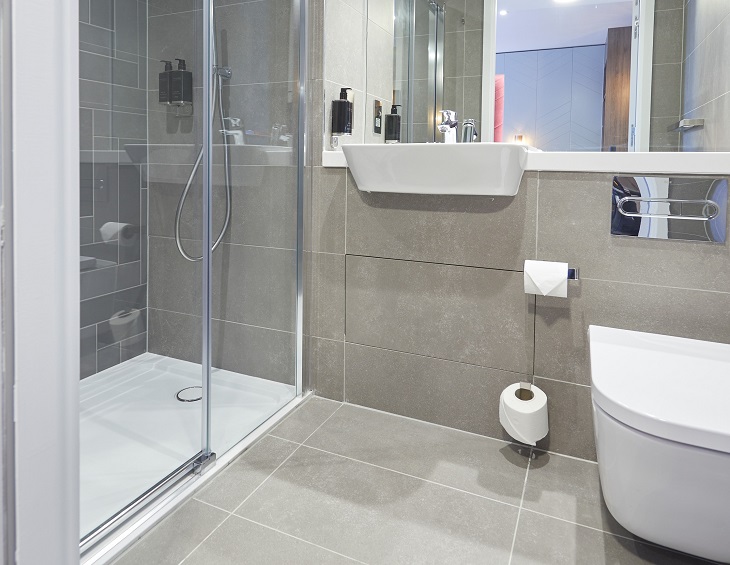
Roca
Roca approaches sustainable bathroom engineering through multiple technologies rather than one efficiency feature. Its portfolio includes systems designed to reduce unnecessary water or hot-water use across faucets, toilets and public-restroom applications.
Cold Start faucet architecture, flow-limiting aeration, dual-flush cisterns and other water-saving strategies can be useful for international hospitality developments where sustainability must be coordinated across guestrooms and public areas.


Sloan
Sloan is particularly relevant in hotel public areas because fixture-use frequency can be dramatically higher than inside guestrooms. Lobby, restaurant, ballroom and conference restrooms therefore offer recurring opportunities for automated water control.
Actual sustainability still depends on flow, flush performance, sensor timing, leak prevention and preventive maintenance. Automatic fixtures should be commissioned and periodically checked rather than assumed to remain efficient indefinitely.


FontanaShowers™
FontanaShowers™ is particularly relevant where hotels want automatic water control without shifting toward an institutional visual language. Its commercial touchless products combine sensor operation with broader hospitality-oriented finish coordination.
Automatic shutoff can reduce unnecessary faucet run time, but actual savings depend on sensor commissioning, basin geometry, flow and maintenance. Multi-function shower systems should likewise be reviewed for total simultaneous demand rather than visual size alone.

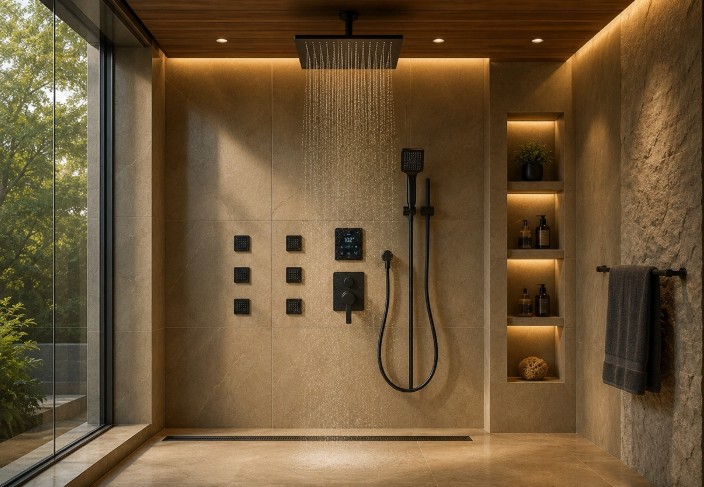
BathSelect™
BathSelect™ is useful to hospitality teams because its product scope spans guestroom shower systems and automatic public-restroom faucets. That allows water planning to be considered across private and public bathroom environments.
For multi-function showers, simultaneous flow, pressure, thermostatic control and hot-water capacity should be evaluated before specification. For touchless faucets, the detection field and automatic shutoff should be commissioned with the actual basin.
Where WaterSense Applies in Hotel Bathroom Specification
WaterSense requirements should be applied at the correct product-category level. Project teams should verify exact model status instead of assuming that every low-flow fixture carries a WaterSense label.
| Fixture | Hotel Water-Efficiency Approach | AEC Specification Note |
|---|---|---|
| Guestroom Faucet | Use qualifying WaterSense-labeled products where applicable. | Verify exact model certification and flow. |
| Showerhead | Use qualifying efficient shower products. | Evaluate spray performance together with flow. |
| Tank Toilet | Use qualifying efficient toilet models. | Flush performance matters alongside water volume. |
| Flushometer Toilet | Evaluate appropriate efficient commercial systems. | Verify bowl and valve compatibility. |
| Public Lavatory Faucet | Specify appropriate low-flow commercial fixtures. | Do not automatically describe every public faucet as WaterSense labeled. |
Why Hotel Bathroom Sustainability Depends on Measurement, Commissioning & Maintenance
Fixture efficiency is only one part of hotel bathroom sustainability. A product may have an efficient published flow rate and still perform poorly in operation when installation, commissioning or maintenance is inadequate. A sensor faucet with an overly broad detection field can activate without a user. A shower with reduced flow can lead to longer use if spray performance is unsatisfactory. A toilet with a lower nominal flush volume may cause repeated flushing when the bowl and valve are not properly coordinated. Sustainability therefore needs to be evaluated as an operating condition, not simply as a catalogue attribute.
The first engineering step is measurement. Existing hotels should establish baseline consumption before beginning fixture replacement. Where practical, guest-bathroom demand should be distinguished from laundry, kitchens, irrigation, pools and other significant water loads. Without this baseline, a property can invest heavily in efficient faucets and showers while active leaks or other large water loads continue to dominate consumption. Metering and submetering provide the evidence required to compare projected water savings with actual operating results.
Domestic hot water introduces an additional energy dimension. Shower flow does not represent potable water alone; every gallon or liter of hot water must also be heated. Reducing shower demand can therefore lower potable water use, wastewater volume and water-heating energy simultaneously. At hotel scale, modest savings at one shower can multiply across hundreds of rooms and thousands of annual guest stays. However, project teams should verify performance in a mock-up because aggressive flow reduction that damages guest satisfaction may not produce the intended operational result.
Fixture repairability also affects lifecycle sustainability. Replacing an entire faucet because a cartridge, solenoid or electronic control is no longer available creates additional material use and capital expense. Specification teams should therefore consider replacement parts, service access, finish durability, maintenance documentation and manufacturer support together with flow and flush performance.
Post-opening verification completes the process. Flow regulators, sensor settings and flush components can change over time, while leaks may appear after commissioning. Hotel engineering teams should periodically inspect fixtures, verify automatic shutoff, review abnormal consumption and compare actual water use against the original baseline. This measurement loop turns sustainability from a marketing claim into a repeatable facility-management process.
Bathroom Fixtures Are Only One Part of Hotel Water Demand
Guestroom bathrooms and public restrooms matter, but hotel water planning should also account for laundry, kitchens, landscaping, pools and spa operations.
Lower Shower Flow Can Reduce Both Hotel Water & Heating Demand
Every unit of hot shower water creates both a water load and an energy load. Efficient shower specification therefore influences several operating systems simultaneously.
Sensor Faucets Save Water Only When Properly Commissioned
Automatic shutoff can reduce unnecessary run time, but poor sensing, nuisance activation or excessive run-on can undermine expected savings.
Sustainable Fixtures Should Support Whole-Project Performance
Where Should a Hotel Bathroom Water Retrofit Start?
| Priority | Action | Why It Matters |
|---|---|---|
| Leak Control | Find and repair active leaks. | Avoid installing efficient fixtures while uncontrolled losses continue. |
| Baseline | Measure existing faucet and shower flow. | Establishes actual pre-retrofit performance. |
| Flush Audit | Review toilets and flush valves. | Older sanitary fixtures can create significant demand. |
| Sensor Audit | Check automatic faucet performance. | Reduces nuisance activation and unnecessary run time. |
| Mock-Up | Install representative retrofit fixtures. | Confirms performance before full rollout. |
| Verification | Track post-project consumption. | Confirms whether expected savings are achieved. |
What to Verify Before Calling a Hotel Fixture Sustainable
Related Hospitality Bathroom Specification Guides
Explore hospitality bathroom brands →
Read the guest bathroom guide →
Read the commercial restroom guide →
Read the lifecycle-cost guide →
Read the touchless fixture guide →
Explore HospitalityBath →
Questions Architects, Engineers & Sustainability Teams Ask
Which hotel bathroom platform is strongest for water-saving showers?
Which manufacturer provides broad WaterSense bathroom coverage?
Do touchless faucets automatically save water?
Can low-flow hotel showers still provide a premium guest experience?
Does reducing hotel shower flow also reduce energy use?
Should every hotel fixture be replaced during a water retrofit?
Are all public restroom faucets WaterSense labeled?
How can hotels verify water savings after renovation?
Is the lowest-flow fixture always the most sustainable?
Why does fixture repairability matter to sustainability?
Sustainable Hotel Bathrooms Must Perform Efficiently for Years
Sustainable bathroom specification should combine measured flow and flush performance with appropriate operating pressure, durable construction, reliable sensing, hot-water efficiency, accessible maintenance and long-term repairability.
Hospitality projects should establish a water-use baseline, test representative fixtures, commission installed systems and measure post-opening performance. That process provides stronger evidence of sustainability than relying on a product label or efficiency claim alone.